

Police forced to rely on volunteers in missing person case due to lack of resources
A force had to wait three days for a specialist underwater search team leaving a family to call in a private company to find their drowned son.
A force had to wait three days for a specialist underwater search team leaving a family to call in a private company to find their drowned son.
Thames Valley Police has referred itself to the Independent Police Complaints Commission (IPCC) after the body of Ellis Downes, 16, was discovered by a team of volunteer divers on Monday (May 9) two days after he went missing
Thames Valley Police launched a search but had to call in specialist support from the Metropolitan Police Service (MPS) which would have arrived three days after Mr Downes went missing because it disbanded its own underwater search and recovery diving unit in 2014.
Independent experts have claimed that in the meantime, the force intended to wait for the body to float up, leaving Mr Downes family to organise the search themselves.
Mr Downes disappeared at approximately 9pm on May 7 after a strong current pulled him underwater at a section of the river Thames near Abingdon.
The following evening, his sister Alex posted a message on Facebook saying the useless police were starting to give up the search already.
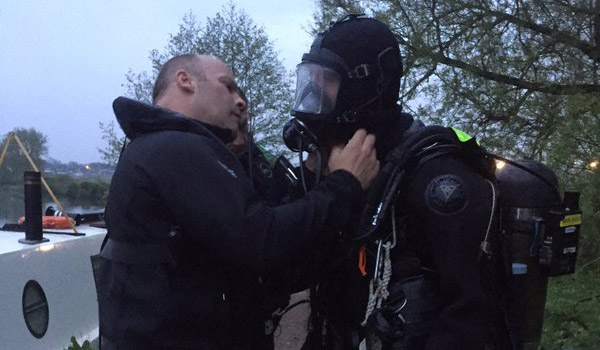
This was seen by National Crime Agency-certified forensic search experts Specialist Group International (SGI), who volunteered to come and assist in the search.
It has been claimed the team was repeatedly refused access to the scene by the police search advisor, and that the search advisor operating at the scene was a PC, when it should have been a sergeant.
When SGI got there, Thames Valley Police warned the involvement of an external search team could hinder a planned and coordinated police search operation.
This meant even though SGI arrived on the scene at approximately 4pm, Mr Downes body was not found for seven hours.
Company founder and CEO Peter Faulding said he was angered by officers who tried to stop his men entering the river, claiming he had never seen such a botched operation in his career.
He added that police refused to help or even speak with the search team, and that around 20 officers stood by and watched as Mr Downes family helped carry the divers equipment to the water.
Mr Faulding told Police Professional: There was zero activity going on near the river absolutely nothing. Police community support officers were standing back as they were not allowed near the water.
Even police officers on the scene were telling me we cant believe what is going on. Weve been told theyre just going to wait for the body to float up.

These claims were repeated by civilian dog handler Dave Marsh, 65, who specialises in locating bodies in water.
After Oxfordshire Lowland Search and Rescue requested Mr Marsh join the search, his specialist dive dog was able to locate two areas where Mr Ellis body was likely to be.
However, Thames Valley Police was unable to act on this information as the necessary resources were not available, and it failed to pass the information onto SIG.
Mr Marsh said: There was [sic] police on boats with grappling hooks in the hope of snagging the body, which is archaic to say the least, and if that was unsuccessful then resources werent available.
Whether resources were financial or personnel, I dont know. So they would have to end the search on the day and await the body surfacing. They would wait for him to come to the surface.
Mr Faulding claimed the force only called for MPS specialist support in response to mounting public pressure.
The MPS is the closest force to Thames Valley Police to have an underwater search and recovery team, as Sussex, Essex, Kent, Hampshire and Dorset forces do not.
Thames Valley Police also has no plans to share a unit across force boundaries, so must wait for the MPS team to become available.
Assistant Chief Constable Nikki Ross said: We are aware of the family and community concerns around our actions following this tragic incident and the referral was made this morning.
I expect the IPCC to respond with a decision on