

Drones providing vital ‘eyes in the sky’ for Cleveland Police
Cleveland Police is the latest force to implement the Drone as First Responder (DFR) concept as part of a national programme that revolutionises how policing responds to incidents.
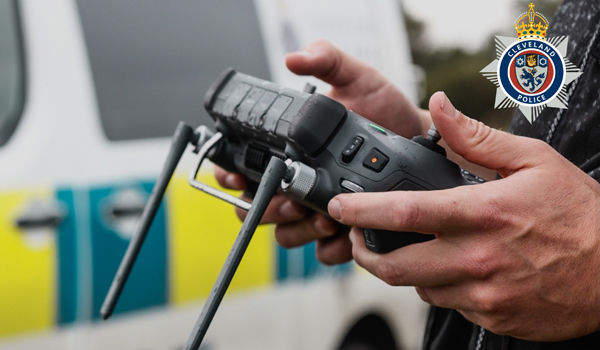
DFR sees drones stationed in weatherproof boxes at locations across the force area, which can be launched and piloted remotely from Cleveland Police’s control room.
The strategically placed drones are able to travel to the scene of an incident in as little as 90 seconds, quickly giving a live-time view of what is happening so resources can be effectively deployed.
The drone pilots can use the drone to follow or locate a suspect, directing officers on the ground to find and intercept them and to quickly respond to reports of vulnerable missing people, getting an almost instant aerial view to aid their location
The drone’s imagery is then available for subsequent investigation or prosecution.
The force says the drones have proved to be “an invaluable asset for policing”.
Since the beginning of this year, DFR has already deployed to 73 live incidents across the Cleveland area.
Cleveland Police offered to adopt the National Police Chiefs’ Council (NPCC) drones programme due to the force’s advanced work in using drone technology to support community and officer safety.
DFR adds additional capacity to Cleveland Police’s fleet of “business as usual” drones, which were deployed 2,185 times during 2025. There are 59 pilots trained across the force, who can deploy drones to incidents including searching for missing people or tracking illegal off-road bikes. They can also be utilised during pre-planned policing operations.
T/Chief Superintendent Martin Hopps, head of Operations at Cleveland Police, said: “Drones have proven to be an invaluable asset for policing in Cleveland, and DFR will only add to this, by improving the effectiveness of our incident response and enhancing early evidence capture at the scene.
“As the first northern force to adopt DFR proactively, we hope to lead the way with this innovative technology in order to protect our communities and tackle criminals.”
Superintendent Taryn Evans, strategic lead for the NPCC drones team, said: “Cleveland Police is the latest force in our early adopters to take on the DFR concept, building on the success of trials in other force areas and embedding it into operational policing.
“The team were already advanced in their use of drone technology so introducing DFR was the natural next step in the force’s innovative approach to tackling crime.
“It’s been really positive to see the force embracing this technology so readily and with several success stories already, we look forward to seeing how things develop.”
DFR is part of a larger NPCC drone programme, which is establishing robust governance, standardisation and sharing of expertise across the UK’s wide network of police drone operators.
The work to date has focused on improvements to the way the 500 drones already flown by UK police officers are operated within visual line of sight (VLOS).
The NPCC says this should lead to increased confidence in police drone operations by the regulator, the Civil Aviation Authority, which should in turn facilitate an easier transition to beyond visual line of sight (BVLOS) and DFR operations in the future.
There are currently several DFR trials and early adopter sites being overseen by the NPCC; Norfolk Constabulary, Thames Valley Police/Hampshire and Isle of Wight Constabulary, West Midlands Police, North Yorkshire Police, Cheshire Police and the Metropolitan Police Service.