
When 'Road Closed' is not enough
From drivers moving traffic cones to widespread Red X violations, policing teams are confronting growing non-compliance on roads and struggling to enforce the law. Police Professional investigates.
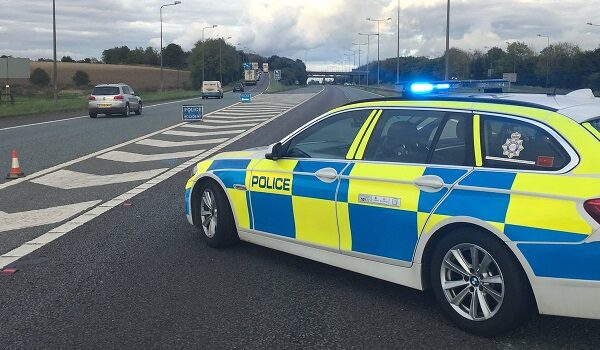
When officers from Derbyshire Constabulary’s Hope Valley Safer Neighbourhood Team responded to a series of traffic collisions across the High Peak in early 2024, they encountered behaviour that will be instantly familiar to roads policing units nationwide.
Rather than paying attention to the signs warning of road closures or the cones blocking off lanes and marking out necessary diversions, many drivers simply ignored them altogether and continued as normal. When challenged, they argued they couldn’t understand the problem as they had easily been able to “fit through”.
Some even went the extra mile by stopping, getting out of their vehicles and physically moving the cones to one side so they could continue their journeys.
The frustration felt by members of the team was obvious in the statement they made to the local press, urging such drivers to reconsider. “We certainly do not put them [cones] out for a laugh,” their spokesperson said.
That frustration has since gained statistical weight.
A new survey from the RAC has found that an astonishing 57 per cent of drivers consider standard red “road ahead closed” signs to be “uninformative” when they see one. Of those, 60 per cent say the signs fail to indicate which road is closed, and 56 per cent say they give no indication of how far ahead the restriction applies. Meanwhile, 15 per cent say they simply don’t trust that the signage is current.
Such views go some way to explaining the low rates of compliance. Only 30 per cent of drivers surveyed said they always follow official diversion signs after encountering a closure. Of the remainder, around 70 per cent rely on local knowledge, 58 per cent worry the diversion will take them significantly out of their way, and just over half default to their sat-nav regardless of what the signs say. A significant proportion – 34 per cent to be precise – simply drive on hoping the closed road turns out to be a different one.
RAC head of policy Simon Williams said the findings showed that “road ahead closed” signs were “not fit for purpose.” He added that drivers ought to be able to trust the signs they are supposed to follow, and that including basic details, such as which road is closed and how long the closure is likely to last – would reduce the likelihood of drivers ignoring official advice.
That argument is harder to dismiss when set against what non-compliance can look like in practice. In February 2024, Kent Police closed the M26 and a slip road at junction 3 of the M20 while emergency services attended a fatal collision involving a van and a lorry. A driver was subsequently charged with dangerous driving and driving without insurance after allegedly ignoring Red X symbols, driving around and moving traffic cones, and proceeding down the closed motorway.
Officers intercepted the vehicle travelling in the direction of oncoming redirected traffic. It was not an isolated case.
Earlier this month Staffordshire Road Crime Team reported that 25 drivers had ignored Red X lane closure signs on the M6 in a single day, each now facing a £100 fixed penalty and three points. The team’s public post noted that officers had witnessed a stranded vehicle turn into a serious injury incident in under five minutes. “When you drive under a Red X,” they wrote, “you’re not just being impatient – you’re putting lives at risk.”
Same roads, fewer officers
Growing driver non-compliance does not exist in a vacuum. It coincides with a decade-long reduction in the number of officers dedicated to policing the road network – a reduction whose consequences extend well beyond enforcement statistics.
RAC analysis of Home Office data found that the number of roads policing officers across the 43 forces of England and Wales stood at just 4,149 in 2025, down from 5,237 a decade earlier. This is a fall of more than 1,000, or 21 per cent. For traffic units specifically, the drop was steeper: from 5,005 officers to 3,889, a reduction of 22 per cent.
For those left behind to pick up the slack, the consequences can be grim. Andy Spence, chair of Leicestershire Police Federation, has described a roads policing environment in which officers are stretched to a point where routine exposure to serious trauma has become the norm rather than the exception.
“We have on average two to three officers on shift policing some of our major road networks every day,” he said. “So that is two or three police officers at work for 12 hours each day policing the M1, the A42, the A1 – and all the other main country roads along some of Britain’s busiest motorways. When there is a serious injury or an accident or a death, then those are the officers who go to it and they are being exposed routinely to all this trauma day in, day out.”
Mr Spence has drawn a pointed comparison with how forces respond to other serious incidents. Where a murder or serious assault occurs, significant detective resource is mobilised. Roads policing operates under no equivalent assumption. The officers available at a fatal collision scene are, more often than not, the same officers who were already covering hundreds of miles of network before the call came in.
The implications for closure management are direct. Intercepting a driver who has moved cones into an active scene requires officers to be present and in a position to act. As traffic unit numbers have fallen by more than a fifth, that presence is increasingly difficult to guarantee. The Hope Valley SNT’s frustration at having to challenge non-compliant drivers while simultaneously managing multiple RTCs reflects a pressure that is very much structural rather than incidental.
The RAC’s Simon Williams has argued that fewer officers in police cars also reduces the fear of being caught breaking the law, and that “the deterrent value of ‘cops in cars’ should not be underestimated.”
The gap nobody owns
When a road is closed following a collision or at a planned works site, the legal framework for managing that closure is relatively clear. The responsibility for signage and traffic management rests with the highway authority or its contractors. The responsibility for enforcement – compelling non-compliant drivers to turn back, or prosecuting those who don’t – rests with the police. In practice, the boundary between those two responsibilities is where the problem lives.
Temporary traffic management contractors have no powers of enforcement. They can position signs, cones and barriers, but they cannot stop a vehicle or issue a fixed penalty. When a driver moves a cone and drives through, the contractor’s options are limited to reporting it. If there is no officer available to respond – and on a network covered by two or three traffic unit officers at any given time, there frequently isn’t – the closure is, in effect, nothing more than an advisory.
The RAC survey finding that only 30% of drivers always follow official diversion signs suggests that a significant proportion of road users have already reached that conclusion themselves. The Hope Valley SNT’s account of drivers arguing at the cordon that they “can fit through the cones” points to something more troubling still: not confusion, but a calculated decision that the closure does not apply to them, and that the consequences of ignoring it are manageable. In many cases, they are right.
The Staffordshire Road Crime Team’s report of 25 Red X violations on the M6 in a single day illustrates the scale of the detection task even where enforcement technology exists. Red X contraventions on smart motorways carry a £100 fixed penalty and three points – but detection depends on camera coverage and subsequent processing. On the wider local road network, where most temporary closures occur, no equivalent automated enforcement exists. The officer at the cordon is the system.
What better looks like
The RAC’s recommendation — that closure signs should state which road is closed and, where possible, for how long — is modest and achievable. An overwhelming 93% of drivers surveyed supported councils and contractors providing more information about where closures are. The demand is not for a technological leap but for basic information that removes the most common justification for ignoring signs: that drivers genuinely don’t know what they’re dealing with.
The government’s Road Safety Strategy, published in January 2026, acknowledges the problem in broad terms. Secretary of State Heidi Alexander’s foreword describes a decade of dangerous complacency on road safety and notes that the UK has slipped from third to fourth in Europe’s road safety rankings. The strategy’s enforcement theme commits to a new Roads Policing Innovation Programme, focused on national coordination and technological approaches – and explicitly recognises that roads policing is a key enabler for improving road safety and that effective roads policing can disrupt wider criminality.
What it does not commit to is rebuilding the officer numbers. Instead of restoring what has been lost, the programme is framed around making the existing capacity work even harder.
An analysis of the strategy by The Police Foundation noted that roads policing has been hollowed out over recent years, with some forces left with minimal or no dedicated capacity, and warned that stronger enforcement powers are meaningless without officers to use them.
It described the strategy as light on how roads policing might be funded or restored, and the Roads Policing Innovation Programme as offering no operational detail.
A three-year Roads Policing Review, jointly led by the Department for Transport and the Home Office, has concluded – but its final report has yet to be published. For those deeply involved in this kind of policing, there is hope it will finally begin to remedy the situation and tackle the decline.
For Leicestershire’s Andy Spence, it’s the roads equivalent of the last chance saloon: “The risk is that the public are going to be exposed to more danger, there is going to be more and more lawlessness on the roads, and there will not be enough police officers there to deal with it.”