Colour by numbers
Improving relations with the black community is high on the police agenda, but the number of officers who identify as black – rather than Asian or minority ethnic – has barely increased in the past decade. Police Professional investigates.

It has now been more than 21 years since the Macpherson report into the police failings that allowed the racist killers of black student Stephen Lawrence to go free was published. It contained a range of recommendations, key among them that police chiefs across the country should take action to ensure their forces looked more like the communities they served by having the same proportion of ethnic minorities as the populations they policed.
Forces were given a decade to achieve this aim – and every single one failed to do so.
In the years since, although the target remains some way off, the situation does appear to have improved significantly, although only when the figures are taken at face value.
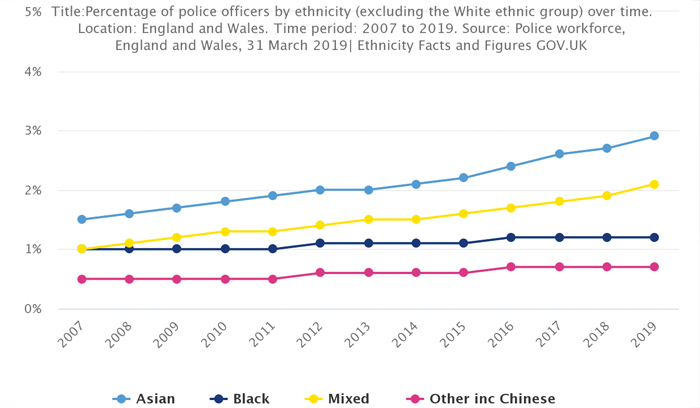
Between 2007 and 2018, the number of black, Asian and minority ethnic (BAME) officers as a whole increased by 43 per cent, even though the overall number of police officers decreased over this period. The number of BAME officers grew from 5,678 in 2007 to 8,126 in 2018.
Whereas BAME officers made up just 3.9 per cent of the workforce in 2007, this increased to 6.5 per cent in 2018. As of March 2019, seven per cent of UK officers identify as BAME – the highest proportion since records began.
But the overall figures hide a more disturbing trend – the number of black officers in England and Wales was found to have risen by just 86 between 2007 and 2018, from 1,412 to 1,498.
A study by the Police Foundation published earlier this year said: “The main driver of increasing police officer ethnic diversity since 2007 has been the recruitment of Asian and mixed ethnicity officers, especially men, while black representation has barely increased.”
The importance of the distinction between black and BAME cannot be overstated. While there is a clearly an issue with diversity within the police and the relationship between police and the BAME community, the problems are particularly acute within black communities.
Anti-racism protests have been held across the UK in the wake of the killing of African-American George Floyd in the US and have increasingly prompted questions on the treatment of black people by British police, particularly in respect of stop and search
Earlier this month, a study conducted within West Midlands Police (WMP) found that a black person was almost four times more likely to be stopped and searched within the force area than a white person. An Asian person was two and a half times more likely to be stopped.
Analysis also found use of force against black people was disproportionate (19 per cent of incidents) when looked at against 2011 census data make-up (six per cent).
The WMP study concluded: “The data shows use of force is disproportionate on the black community rather than the wider BAME community. The force cannot satisfactorily account for this and this warrants further assessment.”
In some parts of the country, black people in particular are up to nine times more likely to be stopped and searched – the highest rate of stop and searches of all ethnic groups in Britain.
These discrepancies have been noted by the likes of Dr Victor Olisa, the former head of diversity with the Metropolitan Police Service (MPS). In a recent article for Sky News, he wrote: “Today there is a growing practice – as often posted on social media and according to anecdotal information I hear from accounts of police training – of officers handcuffing young black boys who have not been arrested and are not resisting or showing any signs of aggression, before they start searching them.
“This happens while white friends who are with them are searched without being handcuffed. This is a worrying development of a practice that seem to reinforce the stereotype that conflates blackness with dangerousness.”
In May 2020, the Independent Office for Police Conduct (IOPC) announced it was investigating nine separate incidents involving excessive use of force against black men by WMP. The following month, it announced a similar inquiry into use of force allegations involving black men in London.
Eight per cent of all deaths in police custody in the UK involve black people, despite the fact they make up just three per cent of the population.
The origins of the acronym BAME go back to the 1970s when different ethnic groups banded together to fight racism under the universal term of ‘black’. By the 1990s, the use of this term was being challenged by some of those groups – British Asians in particular – who argued it gave undue prominence to those from Afro-Caribbean backgrounds.
Initially met with hostility, the idea slowly gained traction and BAME is now widely used. Yet despite this, the term is highly unlikely to be used by members of these communities themselves.
Trevor Phillips, the former broadcaster and politician, has also argued against the use of BAME on the grounds that it sounds “a bit rubbish” and that by classifying all ethnic minorities into the same category, important differences will be lost. He said: “I don’t know what a BAME person looks like.”
In a 2018 interview with the BBC, prior to her appointment as Home Secretary, Priti Patel described the term as “patronising and insulting”. She said: “I don’t like the term. It’s totally unhelpful because we are people and everybody wants to be recognised for their individual merits. I don’t like the labelling of people. I’m British first and foremost, because I was born in Britain.”
There are, of course, many shared experiences between members of all ethnic minorities: all those defined as BAME are likely to have been impacted by racism, either directly or indirectly. They are also likely to find that fewer opportunities are available to them and they earn less.
But there are also stark differences between the groups falling under the umbrella term.
The median gross hourly pay for British Indians is far higher than for the black/African/Caribbean and black British population, and, indeed, higher than the white British population. At the same time, British Pakistanis and Bangladeshis are paid the least.
Those of Indian or Chinese background are performing better in many areas than those originating from other parts of Asia, and Africans are outperforming those from the Caribbean. Even West Africans have very different experiences to East Africans in Britain.
It is no secret that black Britons are far more likely to be stopped and searched, excluded from school, or end up homeless than not only white people, but also their Asian counterparts. According to the Social Mobility Commission, Indians have enjoyed high rates of social mobility within the UK, but this has not been the case for those from black, Bangladeshi or Pakistani communities.
The use of single collective term makes it easy to obscure the shortcomings. By labelling all non-white people as BAME, forces need only to recruit a handful of Asian or mixed race employees to be able to say they are dramatically improving the racial diversity of their workforce and moving closer to becoming fully representative of the communities they serve, even if no black officers have been recruited.
According to Home Office data, five of the nation’s police forces – Durham, North Yorkshire, Warwickshire, Dyfed-Powys and North Wales – had only one black officer each as of March 2019.
The figures showed that 26 of the 43 forces in England and Wales had fewer than ten black officers. These 26 police forces had just 111 officers who recorded their ethnicity as black or black British, among 46,162 in total.
Even the MPS – the largest and most diverse force in the country and currently home to half of all the ethnic minority officers serving in the UK – those falling under the BAME banner are more likely to be Asian, mixed race or ‘other’ than they are to be black.
At present, 14 per cent of the force is BAME. The figure compares with the three per cent of ethnic minority officers in the MPS in 1999. The target is 19 per cent in 2022. Around 30 per cent of those being recruited are from ethnic minority backgrounds, but the MPS admits there are issues with retaining them.
Clare Davies, the director of the MPS human resources, said if the force continues to progress at the current rate it will take 100 years for it to be representative of London’s population.
The National Police Chiefs’ Council (NPCC) lead for workforce diversity, Chief Constable Ian Hopkins, said: “The proportion of black, Asian and ethnic minority officers and staff is at its highest ever level but we recognise we have been far too slow to increase diversity and we know there is still a long way to go so that policing is truly reflective of the communities we serve.
“Everyone in policing knows how important it is that communities can relate to and feel represented by us. The slower rate of progress in recruiting black police officers is likely to reflect the fact that confidence in police has historically been lower among black people than white or Asian – although latest statistics show an improving picture. We’ve been more successful in recruiting black police community support officers and other police staff.”
Earlier this month, in the wake of the global protests in response to the death of George Floyd, the NPCC announced the formation of a working group to address issues around racial inequalities in policing.
The launch announcement stated that the group would include “chief officers with experience of being people of colour within UK policing”. However, only two of the 12 members are from a BAME background and neither is black.
MPS Assistant Commissioner Neil Basu, the most senior BAME officer in the country, is mixed race – the son of a doctor from India and a nurse from Wales.
North Yorkshire Police Deputy Chief Constable Phil Cain, whose mother is Chinese, is also mixed race.
The NPCC says these two are merely members of the initial group and that it will be consulting with people from a wide range of backgrounds over the coming weeks.
Around the same time the working group was unveiled, Mr Cain announced that the proportion of BAME officers in his force had finally matched that of the area’s population.
“North Yorkshire Police is proud to be representative of the communities that we serve. Based on the latest census figures (2011) BAME communities make up 3.4 per cent of North Yorkshire’s population,” he said.
“As of June 17, 3.45 per cent of our officers have recorded their ethnicity as BAME and four of these officers are from a black or black British (African, Caribbean or other black) background.
“We know that we still have work to do to further increase the number of BAME colleagues in our ranks and we have put in place a positive action team to ensure that we actively support applications from BAME candidates to join the force and for promotion.”
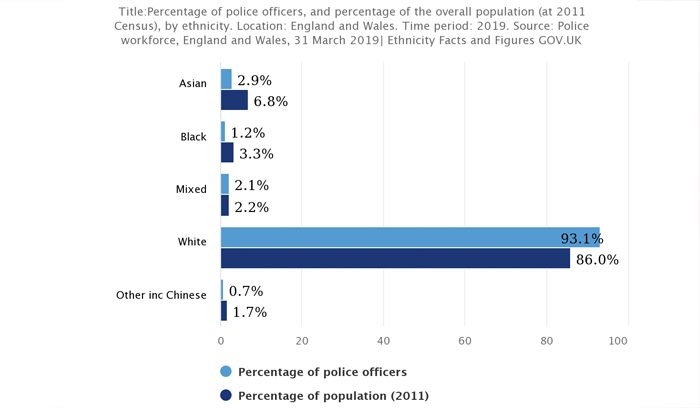
Yet while forces are diversifying at junior ranks, at a senior level there are still huge obstacles. The MPS has no black officers at the highest ranks. Across all forces, four per cent of those ranking chief inspector or above are BAME, compared with eight per cent of constables.
Those who rise higher often encounter difficulties. One of the MPS’s most senior black female officers, Superintendent Robyn Williams, is currently on the sexual offender register after she was found guilty of possessing an indecent image that had been sent to her phone. The decision to prosecute her was labelled a “classic case of institutional racism” by the Black Police Association.
In May, one of Britain’s most senior Indian-origin woman police officers received a confidential settlement with the MPS after taking legal action over allegations of racial and gender discrimination.
Parm Sandhu, a chief superintendent, had claimed she was denied promotions and opportunities at work due to her race and gender.
The settlement was reached after she left the MPS, having been cleared of an allegation of gross misconduct in which she was ultimately found to have no case to answer.
Meanwhile, the 2019 Home Office figures showed there was only one black chief officer in the whole country.
Those members of the black community who decide the best way to change the situation is to do so from the inside face many hurdles. Despite an increase in the level of recruitment targeted at the BAME community, many experience difficulties during the assessment process.
Data provided by the College of Policing shows that while the overall pass rate for the MPS Day One assessment centre for new recruits is 63 per cent, the picture changes dramatically when race is taken into account. While 71 per cent of white candidates pass, only 51 per cent of BAME candidates do.
The 2019 Home Office data also found that while 23 per cent of recruits to the MPS were from BAME backgrounds, voluntary resignation rates were 26 per cent compared to 17 per cent for white officers. Additionally, 2.6 per cent of BAME officers were dismissed compared with 1.2 per cent of white officers.
According to Dr Olisa, a black person choosing to join the police faces a number of challenges: “The journey for many black officers is comparable to them running a 400m steeplechase alongside their white colleagues who are running a 4x100m sprint relay. Consequently, black officers never realise their potential, because the hurdles they must overcome grinds them down and saps away their energy.”
Writing anonymously in The Guardian earlier this month, one black female MPS officer outlined her experiences: “The black community in London is well aware of these problems and deeply resents the police as a result. As a black police officer, this has made my job difficult. Due to the complex political history between the police service and black Britain, officers of colour representing the Met are regularly targeted by these communities when out on patrol.
“Yet white supervisors often overlook this added difficulty for their BAME staff and don’t seem to consider its impact on our emotional wellbeing. I have repeatedly found myself both deflated and exhausted when trying to educate my colleagues on the painful history of policing and the black community. That its legacy has filtered down to our everyday interactions on patrol – a legacy of disproportionate policing fuelled by negative racial stereotypes – inevitably makes the work of BAME officers harder.
“I have been likened to confectionery, heard racist language passed off as a joke and witnessed BAME officers in plain clothes accused of being intruders or told they look like they’ve just left the custody suite by other officers. That’s just in the last 12 months. The offenders continue to hold their jobs and one has even been promoted. So believe me, we understand the black community’s lack of trust in policing.”
Sergeant Tola Munro, president of the National Black Police Association, confirmed such experiences were commonplace and deter many from joining in the first place: “There is a distrust of policing within black communities, particularly among Caribbean communities. Why would you look at policing when you run the risk of discrimination from some of your colleagues?”