
Policing is not an island
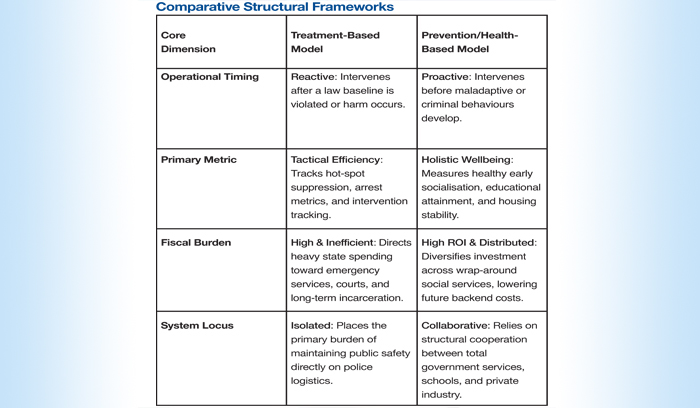
The Research Inspector explores how taking a solution oriented practice approach utilising a ‘health-based’ focus offers more proactivity than current policing models that are overly focused on reactive treatment rather than proactive prevention.

Modern policing is restricted by a reactive, treatment-based operational model. While popularised under the banner of ‘evidence-based policing’ (EBP), this managerial, structural paradigm functions as an expensive triage mechanism that activates only after a societal failure has occurred.
Attempting to repair a fractured criminal justice system (CJS) – currently burdened by severe case backlogs, extreme correctional overcrowding, and declining public trust – solely through the optimisation of police tactics is statistically and fiscally unviable.
True public safety requires transferring the strategic focus away from point-of-failure police logistics. Instead, it advocates for a cross-departmental, preventative health framework that focuses on early child development, adaptive socialisation, and integrated community infrastructure.
Context: the dominance and limits of ‘Shermanism’
The strategic landscape of contemporary law enforcement is largely defined by the principles of evidence-based policing pioneered by Lawrence Sherman. Sherman has been phenomenally successful in the adoption of EBP, yet the question remains to what end? The EBP approach relies on a clinical Triple-T operational framework:
- Targeting: Systematically ranking and directing resources toward high-harm times, places, and people.
- Testing: Conducting empirical research to evaluate which police interventions yield the highest cost-effectiveness.
- Tracking: Utilising digital and biometric metrics to audit compliance and police delivery.
While this methodology has successfully injected rigorous experimental metrics into police deployment, its widespread adoption has introduced a fundamental structural flaw: it conflates tactical optimisation with systemic prevention. By treating public safety as a series of isolated, algorithmically predictable crises, ‘Shermanism’ incentivises police leaders to perfect the management of social decline rather than address its root causes. Rather than perpetually responding to hot spots we should be nurturing cold spots.
The Policy Problem: The Triage Trap and Rebranded ‘Treatment’
Where contemporary policy narratives concerning ‘health-based policing’ fail is their inability to recognise that their design is still inherently treatment-based. They deploy a reactive trigger approach, focusing heavily on measuring the efficiency of clinical intervention after a crime occurs rather than eliminating the environmental factors driving the behaviour.
Remember cause and symptom?
This reactive approach generates severe fiscal and operational challenges, essentially amounting to firefighting within a broken system:
- Escalating Systemic Spillover: The CJS functions as a highly interdependent network. Optimising downstream police efficiency merely accelerates the volume of individuals funnelled into already bottlenecked courts, over-extended youth offending teams, and overcrowded correctional facilities.
- Persistent Dissatisfaction Management: Operating exclusively after the trigger event forces agencies to perpetually ration scarce resources among competing crises. This dynamic guarantees public dissatisfaction and erodes baseline civic confidence.
- The Illusion of Reform: Labelling targeted, hot-spot enforcement as a ‘public health approach’ is a misnomer. It treats the individual offender (the ‘infected host’) while leaving the underlying socioeconomic conditions (the ‘pathogen’) completely unaddressed.
Strategic Alternatives and Policy Recommendations
- De-centre the Police Matrix from Holistic Public Safety
Acknowledge that reducing societal harm – ranging from street-level violence to complex digital exploitation – cannot be achieved by law enforcement agencies acting in isolation.
- Action: Reframe the police as a specialised partner within a broader infrastructure rather than the primary custodian of social order.
- Institutionalise Early-Years Wrap-Around Infrastructure
Shift fiscal appropriations away from back-end situational suppression toward foundational, upstream investments.
- Action: Create integrated municipal hubs that unify early childhood healthcare, proactive family support networks, and trauma-informed education systems. Safety metrics must begin at birth and early childhood development, prioritising healthy socialisation over point-of-failure enforcement.
- Establish a Cross-Government ‘Health-Based’ Funding Formula
Break down conventional agency silos by creating shared funding structures that tie public safety budgets directly to the social determinants of prevention.
- Action: Implement joint budgetary allocations across the Home Office, Department of Health, and Department for Education to actively incentivise preventative intervention over crisis management.
Dr John Coxhead SFHEA, FRSA is Professor of Policing at De Montfort University Business School and Professor of Community Safety at Loughborough University.