Why Andy Burnham should think like a criminal
Keir Starmer’s resignation earlier this week and the near-certain elevation of Andy Burnham to Downing Street, does more than change the occupant of Number 10. It opens a window for a radical rethink of how Britain tackles organised crime on its high streets.

Burnham spent nearly a decade as Greater Manchester’s metro mayor, overseeing a city-region where the direct relationship between economic deprivation, criminal enterprise and blighted high streets is often starkly obvious.
That experience makes him better placed than almost any other politician to take seriously an idea that has been circulating in policing and academic circles for years but has never quite broken through into mainstream policy: that the billions of pounds of dirty money flowing through criminal businesses on Britain’s high streets represent not just a law enforcement problem, but a funding opportunity.
The National Crime Agency estimates there are more than £12 billion of cash-based crime businesses operating across the country, with over £325 billion of criminal money flowing through the economy annually. The Office for National Statistics puts the number of high streets in England and Wales at over 7,000.
What has been missing is the ambition to match the scale.
Current approach
The policing framework that has produced real results in recent years is Clear Hold Build — a three-stage model in which forces clear an area through raids and arrests, hold it to prevent criminal reoccupation, and then build long-term community investment. The government under Starmer continued and extended it, and the operational results have been measurable.
But the Build phase has remained its weakest element as it is dependent on public funding that is increasingly hard to acquire. The new prime minister will inherit a fiscal position in which £70 billion needs to be found for defence commitments alone. The conventional options of borrowing, taxation and departmental cuts are all politically painful.
Which is precisely why what happens inside the Build phase deserves more creative thinking than it has received.
Thinking allowed
The foundation of this is what Professor John Coxhead of De Montfort Business School calls Think Organised Crime Business or Think OCB. Its central insight is disarmingly simple: organised crime is not just gang activity. It is a profit-making business infrastructure, and it should be fought with business tactics as well as criminal justice ones.
Doctoral research by Shane Roberts at De Montfort Business School has explored how business intelligence techniques and hostile takeover tactics — applied to the criminal use of high street property — could do something that traditional enforcement rarely achieves: permanently displace criminal operations and transfer the assets for the benefit of the community.
The principle is not new. Al Capone’s criminal empire was ultimately undone not by proving murders or bootlegging offences but by following the money. Financial investigation succeeded where traditional enforcement had struggled. Think OCB applies a similar philosophy to today’s criminal business infrastructure.
Walk down almost any struggling high street in England and Wales and you are likely to find the same pattern: boarded-up shops interspersed with clusters of cash-only nail bars, vape shops, candy stores and barbershops.
Some are entirely legitimate. Others have repeatedly featured in law enforcement investigations into money laundering, illegal working and organised crime. The problem is not identifying them but rather what happens afterwards.
Revolving doors
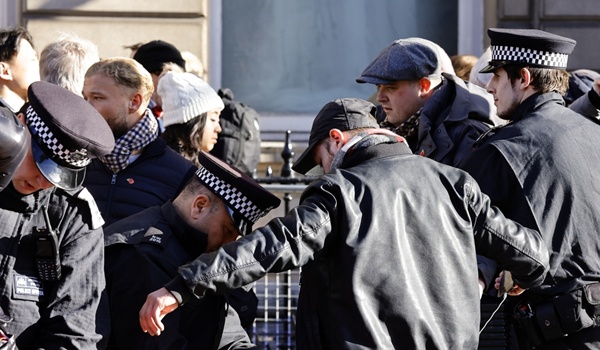
Operation Machinize, launched in 2025, raided 2,734 high street premises and seized assets valued at £10.7 million. At the time, the then Security Minister Dan Jarvis described the businesses targeted as fronts for serious organised crime, money laundering and illegal working.
The results were real but, in many locations, the impact was only temporary.
When one criminal shopfront is taken down, it frequently reappears within hours, sometimes in the same premises, sometimes a few doors down.
The Hold phase has often struggled to address this and the Build phase has rarely had the resources to fill the vacuum with something better.
Instead of simply closing a premises used for money laundering, investigators would seek forfeiture of the property or business assets, transfer them into community ownership or legitimate commercial use, and recycle the proceeds into further regeneration. The objective is not merely to arrest offenders but to replace criminal economic infrastructure with lawful enterprise.
The legislative architecture to go further already exists. The Proceeds of Crime Act 2002 provides powers to forfeit, sell or reinvest assets where criminal profiteering is involved. Unexplained Wealth Orders offer a further tool. What has been missing is the scale of ambition — and the willingness to use civil as well as criminal powers aggressively, targeting landlords whose properties repeatedly host criminal activity alongside the criminal operators themselves.
Opportunity knocks
The argument is that the Build phase could be transformed from a cost into a revenue stream — that a sufficiently ambitious programme of hostile takeovers of criminal property, funded through the proceeds of that same criminal property, could both clean up high streets and generate the community investment to prevent criminal reoccupation.
Burnham’s years in Greater Manchester mean he has seen first-hand how organised crime exploits struggling high streets and how difficult it is to regenerate neighbourhoods while criminal businesses continue to dominate local economies. That experience gives him an opportunity to champion a more ambitious approach—one that sees organised crime not just as something to police, but as something to outcompete and ultimately replace.
The challenge will be translating the framework into legislation robust enough to survive legal challenge while moving quickly enough to stop criminals simply relocating elsewhere.
That will require amendment of existing powers, cross-agency coordination at a scale not yet attempted, and a willingness to accept that some of this will be contested in the courts.
None of that is straightforward. But the alternative of continuing to raid the same premises, seize the same modest sums, and watch the same businesses reopen is not working either.
Criminal enterprises accept the occasional raid as an occupational hazard and build the cost into their business model.
What they are not expecting is for the state to dismantle the business model itself. That, the academics behind Think OCB argue, is the essence of a genuinely hostile takeover.
This feature draws on research by Shane Roberts, a doctoral candidate at De Montfort Business School whose PhD thesis examines the application of business intelligence and hostile takeover tactics to the disruption of criminal high street enterprises.