
Leadership under pressure: an outsider's perspective on the Belfast riots
A US homeland security veteran who watched the PSNI’s response to Belfast disorder from inside its command structure says the discipline of Gold-Silver-Bronze, and the restraint shown under pressure, offer lessons that travel well beyond Northern Ireland.
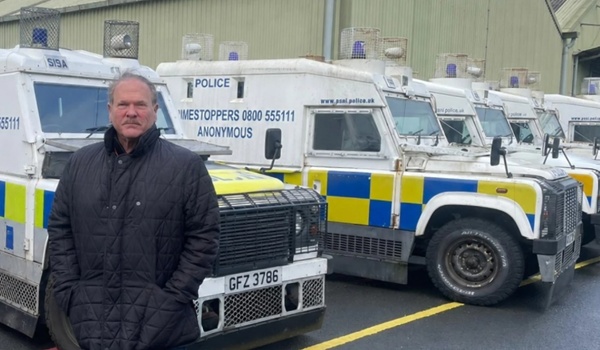
Editor’s note: This article was originally published by Police1.com and is reproduced with kind permission. While written for a North American audience, it offers a rare external perspective on the PSNI response to recent disorder in Belfast and the leadership approaches that shaped it.
Paul Goldenberg, a former senior adviser to the US Secretary of Homeland Security and now chief policy adviser to Rutgers University’s Miller Center on Policing, found himself in a unique position when he visited Belfast as part of a delegation examining public order policing. As disorder spread across the city following a stabbing attack, Goldenberg was able to observe elements of the PSNI response from inside the command environment.
In the article below, he reflects on the leadership, communication and decision-making processes he observed during a rapidly evolving public order operation, offering an outsider’s perspective on command and leadership rather than a broader assessment of the unrest itself.
While his observations are aimed primarily at police leaders in the United States and Canada, they offer an interesting outsider’s perspective on approaches that will be familiar to many British officers.
Public order policing is becoming more volatile across the United States and Canada. Demonstrations can now be shaped within minutes by rapid mobilization, online amplification and crowd dynamics that are difficult to predict. A gathering that begins peacefully can shift quickly, leaving police leaders to make high-stakes decisions under intense scrutiny.
Public order incidents now require more than tactical readiness. They require command clarity, disciplined communication and leadership that holds steady under pressure.
I recently returned from Belfast, Northern Ireland, where I joined a delegation invited by senior leaders from the Police Service of Northern Ireland (PSNI). The group included public safety drone specialists from Draganfly, and the visit focused on public order policing, dialogue-based de-escalation, command decision-making and the role of drone technology in fast-moving public order incidents.
By the end of the first day, those conversations were no longer theoretical.
Belfast was experiencing significant public disorder after riots broke out on June 9, 2026, following a stabbing attack allegedly committed by a Sudanese immigrant the previous evening. Anti-immigration violence spread across multiple areas of the city, with homes, businesses and vehicles set alight, police targeted and simultaneous incidents requiring a coordinated response.
Inside PSNI headquarters, senior leaders tracked developments in real time through a structured command system. On the ground, officers moved into rapidly changing situations with discipline, coordination and the composure that comes from years of operating in difficult public order environments.
What stayed with me was not just the disorder. It was the response.
Built for complexity
The first lesson was the value of command clarity.
Northern Ireland’s Gold-Silver-Bronze command model has long been regarded as one of the most effective public order command frameworks in democratic policing. Many North American agencies are familiar with the concept, but seeing it operate during a live public order incident made clear why it has endured.
The model separates command responsibilities into three levels: Gold Command sets strategic direction, focusing on public safety priorities, community impact and long-term outcomes without getting pulled into tactical decisions. Silver Command connects strategy to operations, translating objectives into tactical plans and coordinating resources. Bronze Command operates on the ground, making real-time decisions as conditions change while staying aligned with strategic intent.
The strength of the model lies in the discipline behind it. Each level understands its role and stays within it. Gold does not micromanage Bronze, and Bronze does not lose sight of strategic intent. Silver keeps the system aligned.
In fast-moving incidents, this clarity affects both the speed and quality of decision-making. Even as incidents developed simultaneously across multiple locations in Belfast, commanders remained focused on their responsibilities without creating confusion or duplication.
Rather than replacing existing frameworks, the disciplined separation of strategic, tactical and operational responsibilities in Gold-Silver-Bronze offers ideas that can strengthen them — creating clarity under pressure.
Dialogue policing in practice
One of the strongest elements of the PSNI response was the use of dialogue policing as a frontline operational tool.
Before situations escalated, trained officers engaged directly with crowds through structured communication intended to reduce tension and create opportunities for de-escalation. This was not casual conversation or informal outreach. It was part of the operational strategy.
Dialogue officers were also connected to the broader command structure, giving commanders insight into crowd sentiment and emerging tensions. In Belfast, dialogue was treated as a tool of influence, not a public relations function.
This approach is gaining attention in the United States through work such as Dr Cliff Stott’s Portland Framework for Dialogue Policing, which emphasises legitimacy, communication, procedural justice and a better understanding of crowd dynamics.
Another defining characteristic of the PSNI response was restraint. The decisions I observed were measured. Timing mattered.
Proportionality was assessed throughout the response. Force remained available, but it was not treated as the starting point.
Maintaining that level of restraint during a fast-moving public order incident is harder than it sounds. Throughout the response, the PSNI appeared comfortable taking a measured approach even as conditions evolved around them — reflecting confidence in both the officers on the ground and the command structure guiding them. In modern public order operations, restraint should not be mistaken for weakness.
Used properly, it is a tactical strength rooted in training, leadership, professionalism and trust in the command structure.
Technology in support of leadership
Technology was another focus of the visit. Discussions with the Draganfly drone specialists centred on a practical question: how can tools such as drones give commanders a clearer operational picture during fast-moving incidents?
The broader lesson was that technology works best when it supports the response rather than driving it. When drones and other emerging tools are properly integrated into command structures and operational doctrine, they strengthen decision-making. When they are not, they can add noise instead of clarity.
Final thoughts
As I left Belfast, I found myself thinking less about the riots and more about the organization that responded to them: a police service operating within a clear command structure, with communication embedded throughout the response and leaders comfortable making difficult decisions under pressure.
That does not mean the PSNI model should be copied wholesale. What Belfast offers is an opportunity to examine specific practices that may strengthen existing approaches: the discipline of Gold-Silver-Bronze command, the integration of dialogue policing and the emphasis on measured decision-making.
The strongest lesson I took from Belfast was the importance of disciplined leadership. Long before officers arrive on scene, the systems, relationships and decision-making processes that guide a response are already being built. When disorder occurs, those foundations matter most.