Seeing the light
For decades, every police force in England and Wales has designed its own blue light warning system for emergency vehicles. The result has been a patchwork of configurations that may affect the safety of officers and the public alike. Now a landmark national programme aims to change that.
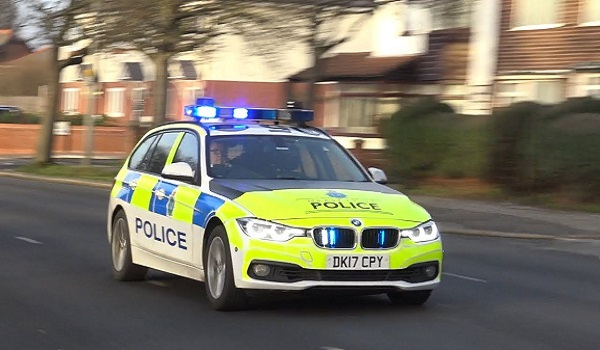
The blue light warning systems fitted to police vehicles are designed to maximise safety in some of the most demanding operational conditions that exist on public roads.
Their initial appearance often leads to confusion. The Doppler effect, along with light bouncing off windows and other vehicles, can mask the direction of the original approach. Despite this, the message is clear: slow down and prepare to make space for fast-moving vehicles appearing suddenly and often against the flow of traffic.
Just how well this message is communicated depends on a variety of factors. The position of the lights on a police car or van – front, rear, side, roof – affects how visible the vehicle is from different angles and at different distances. The intensity of the lights affects how they well they can be seen in different ambient light conditions, from full summer daylight to an unlit rural road at 2am.
This means that, ideally, different operational scenarios will require different configurations. What works on a high-speed response run or during a motorway pursuit is very different from what works when managing a roadside scene and systems that offer only a few options will typically fail to address this.
Research shows that the colour of emergency lights affects how dangerous a situation looks to other drivers, while the type of lighting technology used affects how urgent it seems. The speed at which lights flash also makes a difference – the faster the flash rate, the more urgent the situation appears. Studies have found that a flash rate of around four times per second hits a particular sweet spot for conveying urgency.
The pattern of flashing matters too, though the research here throws up an interesting contradiction. Older studies suggested that a single pulse flashing between four and five times per second was best for conveying urgency, while more recent work found that a double pulse – two quick flashes in rapid succession – was better at making a situation look hazardous. Since urgency and perceived hazard tend to go hand in hand, that discrepancy is something researchers have yet to fully explain.
Given the importance of blue light warning systems, it seems self-evident that someone, somewhere would have taken the time and trouble to establish a consistent, evidence-based approach to work out the best way to configure them.
The reality is that, not only is there no national standard in place, but there has never been one. All 43 police forces across England and Wales have been designing and configuring their own blue light systems independently – by vehicle type, by operational scenario, by the preferences of individual fleet managers, by the legacy of historical procurement decisions, and by the accumulated practice of decades.
Without a shared evidence base or national benchmark, those decisions have largely been shaped by local operational experience, legacy procurement choices and supplier specifications. The result has been significant variation across forces – and, for the first time nationally, recognition that this variation may itself create safety risks for officers and the public.
But now all that is about to change. The Metropolitan Police Service, acting on behalf of the National Police Chiefs’ Council, has commissioned TRL, the UK’s national centre for transport research and innovation, to develop the first ever national Fleet Blue Light Standard for emergency vehicle lighting across UK policing.
Safety gap
The commissioning of a national standard carries an implicit acknowledgement that the current situation is not good enough. “This is the first time UK policing has developed a nationally coordinated, evidence-based standard for blue light warning systems, which are critical to keeping officers and the public safe,” said Jason Powell, Director of Fleet Services Metropolitan Police Service & NPCC portfolio lead.
Curiously, a safety standard already exists for ambulances, according to the National Police Fleet Standards, a four-part suite covering acquisition, conversion and maintenance and disposal of emergency service vehicles. It was itself a significant step forward in bringing consistency to an area of fleet management that had previously been handled differently by different forces.
Also produced by TRL, this time in association with the NPCC and the National Association of Police Fleet Managers, the section on conversion standards explicitly notes that any vehicle fitted with “blue lights or a siren has been modified from the type-approved design” and that this creates specific safety and maintenance demands.
The document notes there are detailed type-approval requirements for ambulances but “no specific requirements for converted police vehicles.”
The threat posed by the lack of standardisation is real, but difficult to quantify precisely in the absence of systematic data. Response and pursuit driving already carry inherent risk. Officers attending roadside incidents face the additional hazard of other road users failing to recognise or respond appropriately to the presence of emergency vehicles.
What the variation between forces means in practice is that the exact same scenario – say a marked police vehicle attending a serious road traffic collision on a rural A-road in poor visibility, for example – could be managed with completely different levels of visual warning, depending on which force’s vehicle is present.
Whether that variation has contributed to specific incidents is a question that the available data cannot answer, because the data has never been collected in a way that would allow that analysis. That, in itself, is part of the problem.
The new national Fleet Blue Light Standard is being developed to cover all marked police vehicle types, from motorcycles and cars to vans and even heavy goods vehicles, across a comprehensive range of operational scenarios.
The standard will be designed to perform effectively in both daytime and night time conditions, across urban and rural environments, and will be grounded in research and real-world operational experience rather than in supplier specifications or accumulated local practice. Frontline officers, response drivers and fleet managers will all have an opportunity to contribute operational knowledge that research alone cannot replicate.
It will sit within the NPCC’s wider Police Vehicle Standardisation Programme: an ongoing effort to bring greater consistency and evidence-based practice to police fleet management across the service.
Ianto Guy, Principal Consultant at TRL, said: “This project represents an important step towards improving safety and consistency across UK policing. By developing a national standard based on robust evidence and real-world operational needs, we can help ensure that emergency vehicle lighting is as effective as possible in supporting officers and protecting the public in a wide range of environments and scenarios.
“This work builds on TRL’s extensive experience supporting police forces across the UK, including the development of the national police fleet technical standard, which helps forces manage their fleets effectively throughout the entire vehicle lifecycle.”
Historic fragmentation
The work is one component of a broader programme that reflects a growing recognition within policing that the historic fragmentation of vehicle procurement and equipment specification across 43 forces has created inconsistencies that carry costs – in terms of money, interoperability and safety.
Those costs have not always been easy to see. When each force manages its own fleet, makes its own procurement decisions and establishes its own equipment specifications, the variation between forces tends to become invisible. There is nothing against which local configurations can be measured or found wanting.
For road policing officers and response drivers, the practical implications of greater standardisation are significant. An officer deploying in support of another force’s operation – a not-uncommon scenario in major incidents, public order situations or cross-boundary pursuits – will be operating in an environment where vehicles may behave differently from those they are used to, where equipment specifications may vary, and where assumptions built on familiarity with their own force’s fleet cannot be relied upon.
A national standard reduces those variables. It means that a response driver from any force operating any marked police vehicle should be able to form reliable expectations about how that vehicle’s warning systems will perform – what they will do, when they will do it, and what other road users can be expected to do in response.
Future proofing
A particular challenge faced by those creating the standard is to ensure such systems are easily able to adapt to future technology and policing needs. The rapid evolution of LED lighting technology, changes in vehicle design and operational requirements already mean that many existing configurations – designed around older technology and older operational assumptions – may be sub optimal.
LED blue light technology in particular has advanced significantly in recent years, offering higher intensity, greater energy efficiency and more precise control of flash patterns and synchronisation. In addition, it offers new possibilities for integrating warning lighting into vehicle body design rather than relying on external light bars.
Some of these advances offer genuine operational benefits but others create new complexities in terms of how lights interact with the visual environment, how they affect the night vision of officers at the scene, and how they are perceived by other road users in conditions of high ambient light or visual clutter.
TRL expects the project to conclude in October 2026 and for the standard to be implemented to all forces soon afterwards. As such, it will provide an early glimpse of the kind of joined-up thinking expected to emerge from the government’s white paper on police reform.