Dressed to suppress?
A German university study places subjects in the midst of a virtual protest march and varies just one thing – what the police are wearing. The results challenge some deep assumptions about public order tactics.
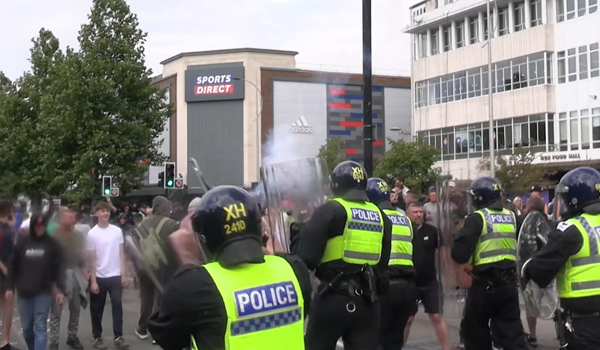
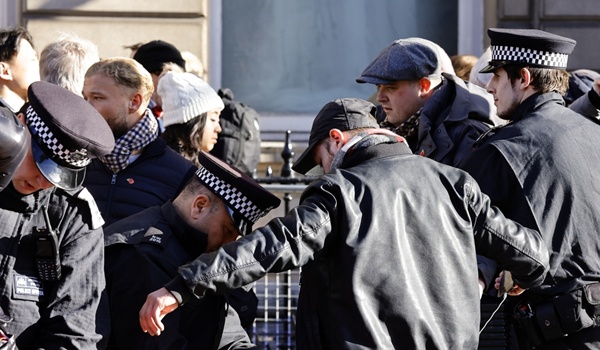
A clear sign that trouble is brewing at a protest march is when the officers on duty don their riot gear. The instinctive idea is that such a visible show of force will act as a deterrent, but a study published in the British Journal of Social Psychology suggests that assumption may be wrong and makes for uncomfortable reading.
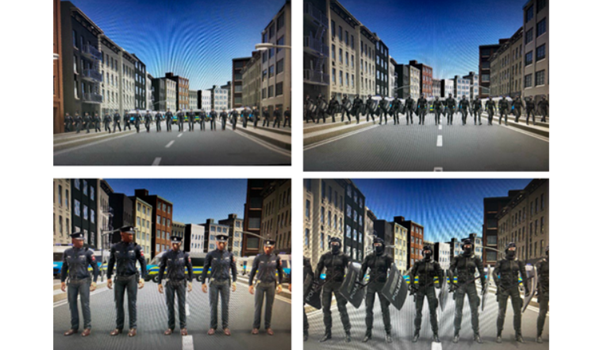
Researchers at the University of Osnabrück in Germany placed participants inside a simulated protest march against right-wing extremism, using a VR treadmill system that allowed them to physically walk through a virtual crowd of around 150 people. At some point during the march, police stepped in to block their path. Half the participants encountered officers in standard uniforms. The other half faced officers in full riot gear, complete with helmets, shields and batons.
The results were clear. Participants who were stopped by officers in riot gear rated the police as significantly less legitimate, more threatening, and less trustworthy than those who encountered officers in regular uniform. In a follow-up experiment, those confronted by riot-equipped officers also showed a greater willingness to actively resist – joining in with chants, signing petitions against police behaviour, or finding ways to continue the protest despite the blockade.
The mechanism driving this was a chain reaction. The presence of riot gear triggered a sense of illegitimacy among the participants, which in turn generated anger, which translated into resistance. The same police action of stopping a march from moving forward produced very different responses depending solely on what the officers were wearing.
A key finding was that participants who initially didn’t feel strongly about the protest movement were found to be likely to harden their attitudes and commit to further protest action when confronted by officers in riot gear. A heavy-handed approach, the research suggests, can radicalise people who might otherwise have remained on the sidelines.
Crowd psychology
The study is grounded in the Elaborated Social Identity Model of crowd behaviour, developed largely by British psychologists John Drury and Steve Reicher over the past three decades.
The theory challenges older assumptions that crowds are inherently irrational or volatile, and that individuals lose their judgement once they become part of a mob.
That view was most famously advanced by nineteenth-century French social theorist Gustave Le Bon, who argued that crowds cause individuals to regress psychologically and become driven by emotion rather than reason.
The Elaborated Social Identity Model takes the opposite view.
Rather than abandoning their values, people in crowds tend to act according to a shared identity and shared norms. Crucially, that identity is not fixed. It can shift depending on what happens around them – and particularly how they are treated by authorities.
Research involving football supporters has shown that when police treat all fans as a single threatening group – by corralling them, restricting movement or deploying heavily protected officers – people who had no intention of causing trouble can begin to feel unfairly targeted.
That sense of injustice can create solidarity with more confrontational elements within the crowd, increasing the likelihood of disorder.
By contrast, studies suggest that dialogue-based approaches – where officers engage, explain decisions and distinguish between individuals and groups – are more likely to encourage self-regulation within crowds and reduce conflict.
The Osnabrück findings suggest similar dynamics may be at play during political protests.
Key variable
Running through all of this research is the concept of legitimacy, specifically, whether people believe that the authority acting against them has the right to do so, and whether they believe it is acting proportionately.
Procedural justice theory, which has been enormously influential in policing research over the past two decades, holds that people’s willingness to comply with authority depends less on the outcome of any given encounter than on whether they feel they have been treated fairly. An officer who explains why they are acting, who listens, and who treats individuals with respect is more likely to secure cooperation than one who simply asserts power – even if the end result is the same.
Riot gear, the study’s authors argue, cuts directly against this. It signals from the outset that the police regard the crowd as dangerous. For protesters who believe their cause is legitimate and their conduct peaceful, that signal is experienced as a profound injustice. The police, rather than being seen as neutral arbiters maintaining order, are perceived as an opposing force. And one that has already decided the crowd is the enemy.
Once that perception takes hold, the dynamics described by the Elaborated Social Identity Model kick in. Even those who were initially ambivalent about the protest, or cautious about more confrontational tactics, begin to identify more strongly with the crowd and to see resistance as justified.
Public order policing
The authors acknowledge the limitations of their research. Their sample was predominantly white, female and highly educated, meaning they were part of a population less likely than many to have had prior negative experiences of police. This may have moderated their baseline perceptions of legitimacy. Real-world confrontations, they suggest, would probably produce even stronger emotional responses than those observed in the virtual setting.
In addition, while the VR platform was sophisticated, it cannot fully replicate the adrenaline and social pressure of an actual demonstration.
Nevertheless, the core finding is robust and consistent with a substantial body of existing research: when people believe they are being treated disproportionately, they push back harder. Riot gear communicates threat, and crowds respond to the message they receive.
For forces grappling with how to police an era of frequent and often deeply felt public protest, that is an uncomfortable conclusion. The equipment intended to protect officers and deter disorder may, under the wrong circumstances, be doing precisely the opposite.
References
Becker, J. C., Hartwich, L., & Radke, H. R. (2025). The effect of apparent Police power at demonstrations against right‐wing populism on Protestors’ resistance using a virtual reality experiment. British Journal of Social Psychology, 64(2), e12809.