
New AI tool detects abusive behaviour
Researchers from the University of Huddersfield have developed a hybrid AI tool to detect patterns of psychological abuse, including coercive control, in a bid to transform digital forensic investigations and mental health research.
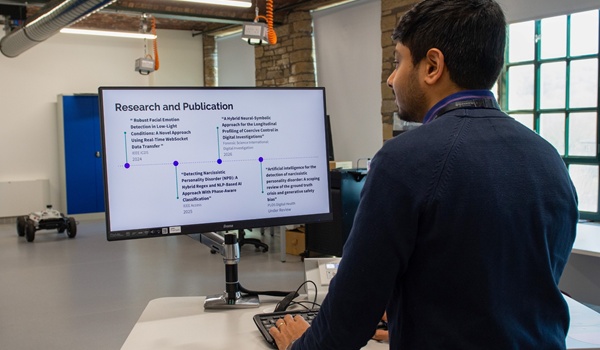
This innovation was developed as a primary outcome of Researcher Dhruv Patel’s PhD work under the mentorship of senior lecturer Dr Anju Johnson and is designed to address a bottleneck in modern digital forensic investigations, integrating insights from a broader research team to ensure its real-world application.
The team from the University’s School of Computing and Engineering sought to address the challenge of finding evidence of psychological abuse, such as patterns of coercive control – where one individual exerts power over another – within large volumes of digital data such as text messages or chat logs.
Such “hidden abuse” is notoriously difficult to capture as evidence because it rarely involves a single violent incident. In addition, evidence of this type of abuse is overwhelmingly digital and standard forensic keyword searches often miss its cumulative nature, such as a pattern of gaslighting, isolation or humiliation.
The Huddersfield team’s solution was to bridge this “data-to-insight gap” by creating a framework they call the Digital Conversation Analysis Pipeline (DCAP), which identifies linguistic indicators of narcissistic abuse cycles, associated psychological manipulation patterns, and related traits in textual data. Their latest findings have been published in the respected journal Forensic Science International: Digital Investigation as well as IEEE Access.
DCAP uses a hybrid artificial intelligence approach, combining the precision of rule-based forensic keyword searches with the contextual understanding of a deep learning model to catch things like sarcasm and manipulation, even when it is disguised in modern slang or buzzwords.
The system itself operates as a “human-in-the-loop” framework, with this approach avoiding opaque “black box” algorithms and clearly highlighting the exact evidence used to reach its conclusions.
It specifically scans for linguistic markers matching the nine diagnostic criteria of Narcissistic Personality Disorder, part of the dark triad of aversive personality traits. These are associated with abusive behaviours and include a “lack of empathy” and a “strong sense of entitlement” – vital early-warning signs for investigators tracking patterns of systemic abuse.
The tool itself acts as a triage system, flagging any abusive patterns and guiding investigators to the most critical evidence as a decision-support framework. In a simulated forensic case of over 8,400 messages, DCAP successfully narrowed this down to 287 key messages containing the most prevalent abusive traits and reduced the investigator’s manual review workload by over 92 per cent.
This Huddersfield-led innovation has possible applications in digital forensic analysis and studies of coercive and abusive communication dynamics, as well as supporting mental health research. It also has the potential to become a powerful asset for police and forensic investigators worldwide, due to its ability to provide high-fidelity evidence that was previously unreachable, which can be used as expert witness testimony.
Mr Patel, who was awarded a Vice-Chancellor Scholarship by the University for his PhD research, commented: “The sheer volume of digital data in modern investigations makes it incredibly difficult for human analysts to spot the subtle, long-term linguistic markers of narcissism and psychological abuse. By integrating textual analysis with the evaluation of human emotion via computer vision, we are moving towards a truly multimodal approach. This ensures that no nuance is missed, providing an essential framework for both forensic investigations and complex mental health diagnosis.”
Dr Johnson added: “As lead supervisor of this research, I have seen how it transforms the way we approach digital evidence. This Huddersfield-led innovation is a cornerstone for the modern justice system, providing a scientifically rigorous bridge between raw data and psychological truth. By quantifying the hidden dynamics of personality disorders and abuse, we are giving prosecutors and the judiciary a transparent, objective toolkit. This doesn’t just clear forensic bottlenecks; it ensures that the voices of the most vulnerable are backed by undeniable, trial-ready data.”