

Victims and survivors at heart of outstanding work to tackle VAWG
A ground-breaking stalking unit, a survivors’ network and a safeguarding initiative that creates safe spaces in communities were among the winners at the National Centre for Violence Against Women and Girls and Public Protection (NCVPP) annual recognition event.
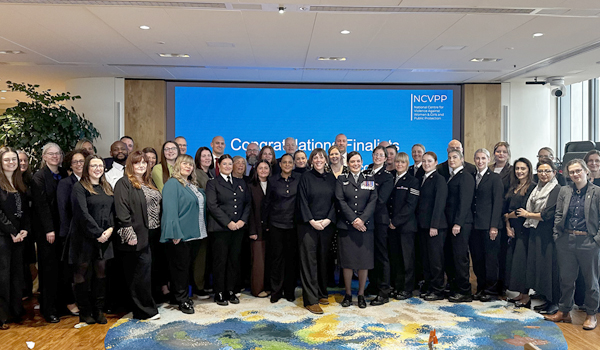
It is designed to recognise outstanding work across policing and partnerships.
More than 100 people attended the event at the end of last month to commend the winners and runners up for the six categories, which included: improving police culture, making spaces safer and keeping vulnerable people and communities safe.
More than 75 entries were received, and the winners were selected through a series of panels, which included judges from the specialist sector and academic experts.
All winning entries had to demonstrate how they built innovation into their activity, how their approach was victim-centred and the impact it has had, and will continue to have, in tackling violence against women and girls (VAWG) and keeping the public safe.
Judges were impressed with the quality of the entries, praising officers, staff and volunteers who listened to victims and survivors, and then shaped their activity accordingly.
Deputy Assistant Commissioner Helen Millichap KPM, director of the NCVPP, said: “It’s been an honour to award these brilliant police officers, staff, volunteers and partners today. Hearing the inspirational citations about their work, which tackles VAWG and protects the public, reminds us all of the importance of the task we are undertaking and the great work that is already happening across the country that we can build on.
“I want to thank everyone who helped us select the winners, and also those who nominated the brilliant work we have seen across every category. Spotting and sharing outstanding activity is what creates change that reaches beyond individual projects and allows us to influence national policing. Most of all I am grateful to all of those, winners or not, who are steadfastly making a difference to the public and to victims of crime, often out of sight and too often not celebrated.”
Ellen Miller, chief executive of Safe Lives, said: “I have been part of this reward and recognition event since its inception three years ago and I’ve been able to see how police forces have strengthened their approach. I’ve also seen the breadth of activity underway to tackle VAWG and protect the public from harm.
“SafeLives is dedicated to ending domestic abuse, and policing has a critical role to play in helping survivors get safety and justice. The work recognised today shows what’s possible when forces listen to victims, work alongside specialist partners, and respond with consistency, care and professionalism. We need to see this approach embedded everywhere, with robust standards, trauma-informed practice, effective risk assessment, multi-agency action and clear accountability so perpetrators are identified, challenged and stopped – and survivors are believed, protected and supported to recover.”
Jess Phillips, Minister for Safeguarding and VAWG, said: “A woman is killed by a man on average every three days in the UK. That’s why the work of the police is so vital to tackle abusers and protect victims from harm.
“These awards celebrate officers who refuse to look away from that reality, so thank you to all those officers who dedicate their lives to protecting the public.
“But this mission continues with the launch of our new VAWG strategy. We will deploy the full power of the State to make this country safe for women and girls.”
Among the winners was Cheshire Constabulary’s pioneering Harm Reduction Unit (HRU), which won the collaborative working leading to victim-centred investigations category.
The HRU has transformed the policing response to stalking through a pioneering, victim-centred model that shifts the burden from victims to perpetrators.
Its approach has delivered outstanding results with the highest charge rate for stalking and harassment nationally, a 98 per cent conviction rate for cases reaching court, and a huge increase in Stalking Protection Orders – from one every 39 days to one a week.
The HRU also secured the longest stalking sentence in UK history. Victims describe the service as “life-changing” and “life-saving,” reflecting a culture where safety and dignity are paramount.
Cheshire Constabulary Assistant Chief Constable Carlos Brunes said: “We are extremely proud of the Harm Reduction Unit and the work the team continue to do to keep vulnerable people safe across Cheshire.
“Protecting victims is at the forefront of the unit’s mind from the start of any investigation, and the results we are seeing and the winning of this award is a credit to the team’s success in doing this.
“Working with partners including the Cheshire and Wirral Partnership NHS Foundation Trust (CWP), Mersey Care NHS Foundation Trust and the Probation Service is also crucial to this success.”
Dorset Police had two finalists at the annual recognition event, with its Survivors Network the winner in the category for improving culture and conduct within police forces.
The network offers support to officers and staff affected by sexual harassment, domestic abuse and other forms of VAWG.
It was co-designed by survivors to ensure dignity, equity and justice are embedded within the organisational culture and provides a confidential, trauma-informed safe space for staff to be heard.
The network was recognised as a “transformative force for compassion, fairness and accountability within policing”.
The Pineapple Project, a partnership scheme with Dorset Council, was also the winner in the making spaces safer category.
The pioneering scheme was launched in Weymouth in 2022 to tackle hidden harms such as peer-on-peer abuse and exploitation. It involved setting up a network of Community Guardians – local businesses and volunteers – who were trained to provide safe havens for girls and young women.
The project now has more than 60 guardians who help to foster a culture of active upstanders and collective responsibility.
The project was recognised for its combination of ‘community empowerment, education and partnership working’.
Detective Superintendent Neil Wright, Dorset Police’s operational lead for VAWG, said: “We are committed as a force to demonstrate that we are here for the safety of women and girls.
“As well as working to support victims and tackling VAWG-related crime, these two vital projects show that we are also focussing internally on providing support to our own staff as well as working with partners to offer spaces in our communities where women and girls can feel safe.”
A pioneering early intervention initiative supporting young people who go missing – Operation Satin – won a Special Recognition Award for exceptional work in tackling VAWG.
Developed in response to a rise in first time missing episodes, Operation Satin fills a critical gap in safeguarding. By engaging young people at the earliest opportunity, before patterns of repeat disappearance or exploitation can take hold, the initiative reduces vulnerability and prevents harm from escalating.
Delivered jointly by the Office of Northamptonshire Police, Fire and Crime Commissioner and Northamptonshire Police, the programme provides trauma informed, needs led support from specialist early intervention practitioners.
Assistant Chief Constable Emma James said: “We are delighted that Operation Satin has received this award. The work the early intervention workers do alongside our police team is invaluable. This joint collaboration has undoubtedly made an enormous difference in keeping young people safe in Northamptonshire and the team rightly deserves national recognition for this transformative work.”
When a young person returns home after a missing episode, practitioners visit them to understand the reasons behind each incident and help prevent it from happening again. Support includes emotional regulation, mental health guidance, healthy relationships advice, online safety, and help with risky behaviour. Families and carers are also offered tailored support to strengthen relationships and address the underlying challenges contributing to missing episodes.
Police, fire and crime commissioner Danielle Stone said: “Operation Satin is transforming how we safeguard vulnerable young people in Northamptonshire. By intervening early, with skilled and compassionate practitioners, we are preventing harm before it escalates and reducing the risks associated with going missing.
“I am incredibly proud of the team and delighted that their dedication has been recognised nationally.”
The force said Operation Satin not only alleviates demand on policing but also transforms outcomes for some of the most vulnerable children in the county. It is now recognised as a benchmark for national best practice and a powerful example of what can be achieved when empathy, innovation and evidence based practice come together to protect those most at risk.
Full list of winners:
Category 1: Collaborative working leading to victim-centred investigations
Winner – Harm Reduction Unit (Cheshire Constabulary)
Runner-up – Homicide Investigation Team (West Midlands Police)
Category 2: Improving police culture and conduct within forces
Winner – The Survivor’s Network (Dorset Police)
Runner-up – Surrey Police Communications Team
Category 3: Suspect focused initiatives and/or investigations
Winner – Detective Sergeant Chloe Wilson (Metropolitan Police)
Runner-up – Detective Chief Inspector Brett Harris (Suffolk Police)
Category 4: Keeping vulnerable people and communities safe
Winner – NPCC Vulnerability Communications Hub (Child Sexual Exploitation Taskforce)
Runner-up – Sussex Police Detective Superintendent Karrie Bohanna, Detective Chief Inspector Joanna Cooper, Detective Constable Owen Watkins, Detective Constable Vicki Blythe.
Category 5: Making spaces safer
Winner – The Pineapple Project (Dorset Council)
Runner-up – Phil Ashford (Hydrant Programme)
Category 6: Special recognition
Winner – Operation Satin (Northamptonshire Police and OPFCC)
Runner-up – Yasmin Akhtar (Go-Women Alliance & Count Me In)